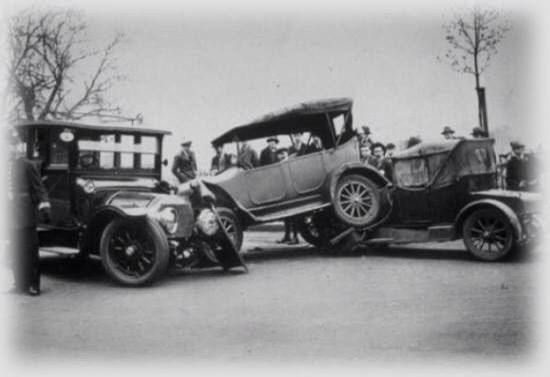
Today, modern cars can exceed 300km/h, accelerate faster than fighter jets from decades ago and come packed with advanced safety systems. Yet the very first recorded car crash in history reportedly happened at a speed so slow it would barely frighten most drivers today: around 8mph (13km/h).
It sounds almost ridiculous now, but in the late 1800s, automobiles were still experimental machines. Roads were not designed for cars, traffic laws barely existed and people had no idea what dangers these “horseless carriages” would eventually introduce to society.
That first crash would become the beginning of an entirely new problem humanity had never faced before: road accidents.
The Story of the World’s First Car Crash
The first widely recognized automobile crash happened in 1891 in Ohio involving a man named James William Lambert.
Lambert was driving one of the earliest gasoline-powered single-cylinder vehicles when he lost control and crashed into a tree root, causing the vehicle to veer and hit a hitching post.
No one died in the accident, which is remarkable considering the complete lack of safety equipment at the time. There were no seat belts, airbags, crumple zones or even proper steering systems.
What makes the story fascinating is how incredibly slow the vehicle was moving. Estimates place the speed at roughly 5–8mph.
By modern standards, that is jogging speed.
Cars Were Still a Crazy Idea
To understand why this crash mattered, you have to understand how strange automobiles seemed back then.
In the 1890s:
- Most transportation still involved horses
- Roads were rough and unpaved
- Fuel stations did not exist
- Traffic lights did not exist
- Driver training did not exist
- People genuinely feared automobiles
Cars were noisy, unreliable and intimidating. Many people believed they were dangerous machines that would never replace horses.
Ironically, the first crash almost helped prove those fears right.
The First Car Accident Fatality Came Soon After
While the Lambert crash caused no deaths, the first recorded pedestrian death involving an automobile happened just a few years later in 1896 in London.
A woman named Bridget Driscoll was struck by a car while crossing the road.
Witnesses claimed the vehicle was moving at a “tremendous speed.” The actual speed? Around 4mph to 8mph according to reports from the era.
At the time, even those speeds felt terrifying because humans simply were not used to machines moving independently on roads.
Why Early Cars Crashed So Easily
Driving early automobiles was incredibly difficult.
Some of the problems included:
- Primitive steering systems
- Weak brakes
- Poor tire grip
- No windshields
- Terrible road conditions
- Unpredictable engines
Many early cars behaved more like mechanical experiments than reliable transportation.
Even starting the engine could be dangerous. Hand cranks were notorious for violently kicking back and breaking drivers’ wrists.
The Crash That Started Road Safety
The first car crash may seem minor now, but it marked the beginning of a global challenge that still exists today.
As automobiles became more common, governments slowly introduced:
- Speed limits
- Driver licensing
- Traffic laws
- Road signs
- Vehicle safety regulations
Eventually, innovations like seat belts, airbags and anti-lock braking systems became standard.
Ironically, modern cars are infinitely faster than the vehicles of the 1890s, yet they are also dramatically safer.
The Strange Evolution of Speed
One of the funniest parts of this story is how society’s idea of “fast” has changed.
In the late 1800s:
- 8mph felt dangerous
- People feared cars would terrorize cities
- Some believed humans could not survive high speeds
Today:
- Highway speeds regularly exceed 70mph
- Supercars exceed 200mph
- Formula 1 cars can corner faster than early airplanes
Human beings adapted surprisingly quickly to speed.
The world’s first car crash happening at just 8mph feels almost comedic now, but at the time it represented the birth of an entirely new era.
The automobile would go on to reshape cities, economies, warfare, culture and daily life itself. Along with that transformation came accidents, traffic laws and the endless pursuit of safer transportation.
Every modern crash investigation, every airbag and every road safety law can trace part of its history back to those first awkward moments when humans began learning how to live with cars.
And it all started with a crash barely faster than a bicycle.