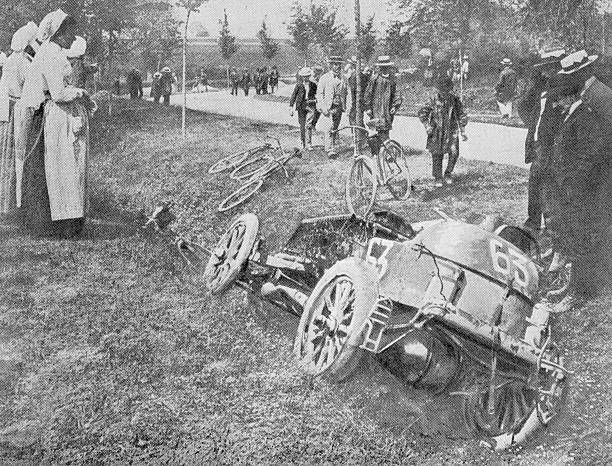
The 1903 Paris–Madrid race was meant to be the greatest automobile competition ever organized — a celebration of engineering, courage, and progress.
Instead, it became the race that nearly killed motorsport before it truly began.
A World Obsessed With Speed
By the turn of the 20th century, Europe had fallen in love with automobiles. Earlier races like Paris–Rouen and Paris–Berlin had drawn massive crowds, and manufacturers realized something important:
Winning races sold cars.
Automakers such as Renault, Panhard, Mercedes, and De Dietrich saw racing as advertising at full throttle. Faster cars meant prestige, innovation, and national pride.
So organizers planned something bigger than ever before.
The Ambition: Paris to Madrid
The 1903 event, officially called the Paris–Madrid Trial, was designed as a multi-day endurance race stretching across France and into Spain.
The Plan
-
Start: Versailles, near Paris
-
Finish: Madrid, Spain
-
Distance: Over 1,300 kilometers (800+ miles)
-
Date: May 24, 1903
-
Entries: Nearly 300 vehicles, including cars and motorcycles
It would be the longest and fastest automobile race ever attempted.
There was just one problem.
The world wasn’t ready.
Racing Without Rules
Modern racing fans expect barriers, marshals, medical crews, and safety zones.
In 1903, none of that existed.
The race ran on open public roads.
That meant:
-
Farmers still used the roads
-
Animals crossed freely
-
Spectators stood inches away
-
Dust clouds blinded drivers
-
No speed limits
-
Almost no policing
Cars capable of 100 km/h (60+ mph) blasted through villages built for horse carts moving at walking speed.
It was less a sporting event and more a rolling experiment in controlled chaos.
Dawn of the Race: Excitement Turns to Panic
Before sunrise, thousands gathered near Versailles to witness history.
Cars started individually at timed intervals beginning around 3:30 a.m. Drivers wore goggles, coats, and enormous bravery.
Engines roared. Crowds cheered. Dust filled the air.
Within minutes, accidents began.
Why Everything Went Wrong So Quickly
Several factors combined to make the race dangerously unpredictable.
1. Dust — The Invisible Enemy
Unpaved roads created massive dust clouds.
Drivers often couldn’t see:
-
The road ahead
-
Other cars
-
Spectators
-
Sharp turns
Many crashes happened simply because drivers were effectively blind at high speed.
2. Cars Were Faster Than Their Technology
Early racing cars had:
-
Weak brakes
-
Poor steering control
-
Fragile tires
-
No seatbelts
-
No helmets as we know them today
Mechanical failures were common — and catastrophic.
3. Spectators Were Everywhere
Fans lined the roads, sometimes stepping into the racing line at the last second.
There were no barriers separating machines from people.
The excitement of speed became deadly proximity.
The Tragedies
As the race continued south toward Bordeaux, reports of crashes multiplied.
Several drivers were injured. Spectators were struck. Cars overturned or broke apart at speed.
One of the most shocking moments involved Marcel Renault, co-founder of Renault and one of France’s most famous racers.
He crashed during the event and later died from his injuries.
News spread quickly, turning celebration into national alarm.
Officials Realize the Race Cannot Continue
By the time competitors began reaching Bordeaux — roughly halfway to Madrid — the scale of disaster was undeniable.
Authorities faced a decision never made before in motorsport history.
They stopped the race.
The French government ordered:
-
The competition officially canceled
-
No racing allowed beyond Bordeaux
-
Drivers to continue only under normal road conditions
There would be no triumphant finish in Madrid.
No official winner.
Only a lesson learned at enormous cost.
Why the Paris–Madrid Race Changed Motorsport Forever
The aftermath shocked Europe.
Public opinion turned sharply against uncontrolled racing, and governments demanded change.
The consequences reshaped motorsport:
City-to-City Racing Was Effectively Banned
Long-distance public road races disappeared almost overnight.
Dedicated Racetracks Became Necessary
Events moved toward closed circuits where safety could be managed.
Regulation Was Born
Organizers began introducing:
-
Safety oversight
-
Controlled spectator areas
-
Technical rules
-
Professional race management
Modern motorsport’s foundation began here.
The Irony of Progress
The Paris–Madrid race was meant to prove automobiles were the future.
It succeeded — but not in the way organizers expected.
It revealed both the incredible potential of cars and the danger of innovation without structure.
From its failure came:
-
Racetracks
-
Safety standards
-
Organized championships
-
Professional drivers
In short, the disaster helped create modern racing.
The Legacy: The Race That Saved Motorsport
Today’s Formula 1 circuits, NASCAR ovals, and MotoGP tracks exist partly because of what happened in 1903.
Every safety barrier.
Every marshal post.
Every racing regulation.
All trace back to the moment motorsport realized speed needed responsibility.
The Paris–Madrid race didn’t end racing.
It forced it to grow up.
Final Thoughts: When Racing Learned Its Limits
Motorsport has always lived on the edge between bravery and danger.
In 1903, that edge was crossed.
But from tragedy came transformation — turning reckless competition into the structured, thrilling sport millions love today.
The race meant to crown the fastest car instead created something far more important:
The future of racing itself.